




Five booths, ten square meters each, and not one of them paid for. ince 2024, Discover a Talent has given these booths to artists free of charge at the Discovery Art Fair Frankfurt.
Initiated by curator Kai Brückner, the program allows every exhibiting gallery to nominate one artist who has never shown at the fair, and five are then selected by a jury. This year that jury is Silke Hohmann of Monopol, art historian and gallerist Jörk Rothamel, curator Dr. Gregor Jansen, former director of Kunsthalle Düsseldorf, and Raimund Stecker, founding director of the Arp Museum Bahnhof Rolandseck.
This year, the program’s name deserves a footnote. Several of this year’s five arrive with museum shows, state honors and curatorial projects behind them, so “discovery” here means something closer to introduction. They were selected as artists new to this fair, and for most visitors here they are new names. That is the point: a fair is one of the few places where an artist can meet a whole new audience in a single weekend.
Though chosen from separate nominations, the five talk to each other remarkably well. Walls, rooms, and houses that seem to look back recur in three of them, and in each case the architecture is really about an inner state. An architect turned hyperrealist paints everyday objects with a stillness that borders on the uncanny. A London artist builds faces from one unbroken thread and sometimes takes them down as soon as they are finished. Across the five, the shared preoccupation is what holds still, and what refuses to.
Gan-Erdene Tsend – Booth A4, Galerie am Dom
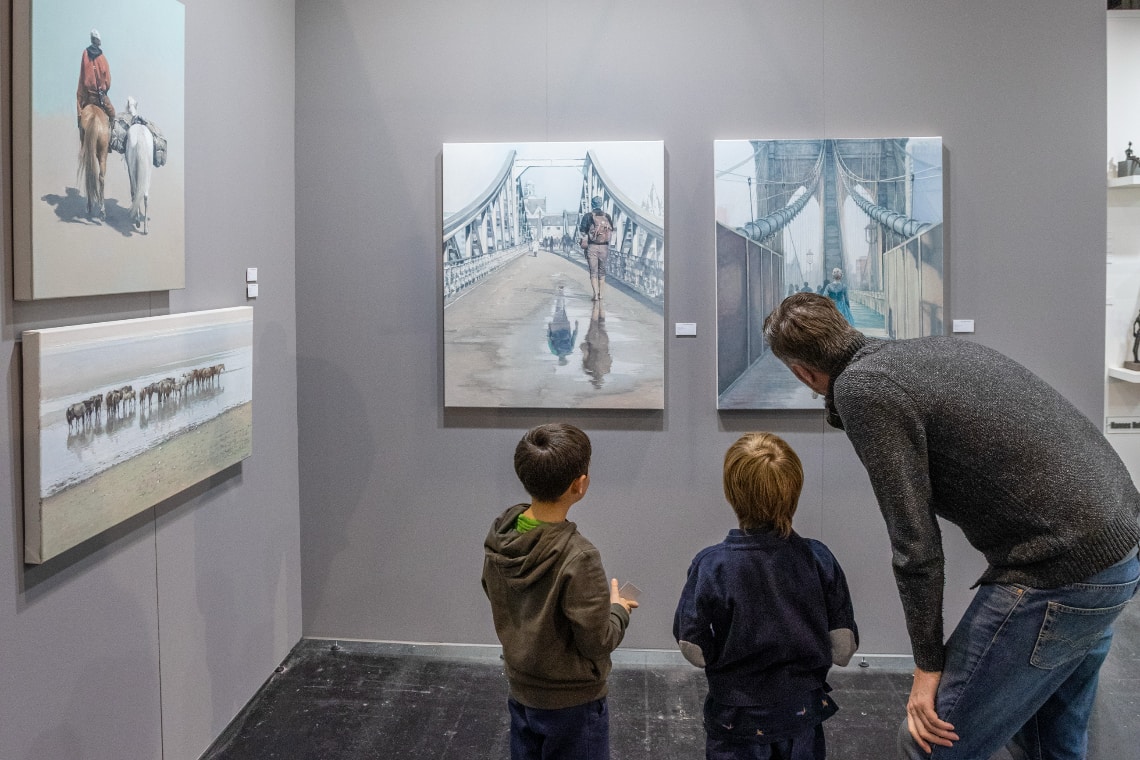
The selection of Gan-Erdene Tsend makes a case worth making: his work deserves far more attention than it currently receives. Born in 1979 in Mörön, Mongolia, he studied in Ulaanbaatar and then at the Kunstakademie Münster, where he became a Meisterschüler under Hermann-Josef Kuhna. His paintings set precisely observed rooms beside shadowy apparitions, and use reflections as the seam where memory and longing leak into the visible. Carousels, horses, and titles like Heimweg (the way home) and Völkerwanderung return across his series; one Heimweg stretches to 260 by 720 centimeters. In 2022 he was named Mongolia’s cultural envoy to Germany. Looking at the paintings, the title feels less like an honor than a job description.
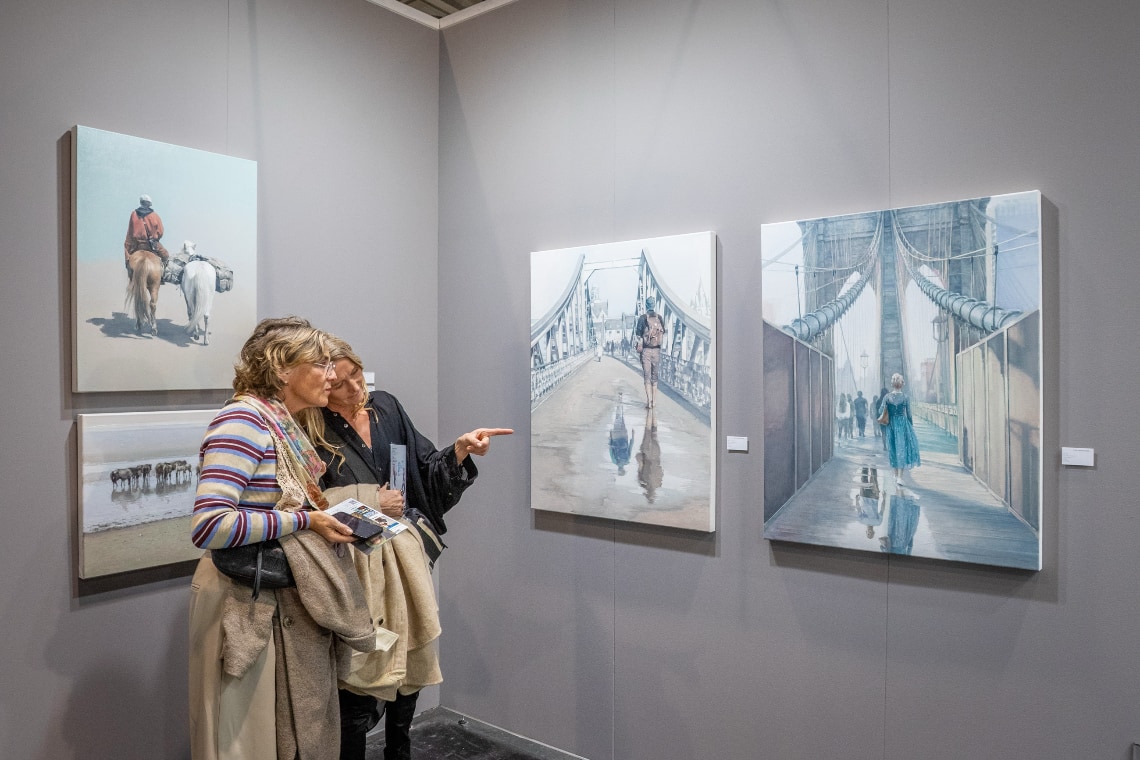
Gan-Erdene Tsend – Galerie am Dom – booth at DAF, photo by Holger Peters
David Luca Muth – Booth D3, Gallery artpark
The titles get you first: sorry i did wrong again, waiting for the sword, my house is watching you. David Luca Muth writes them in lowercase, deadpan English and paints them in flat, saturated acrylic. His pictures are full of brick walls, houses whose windows read as eyes, and hooded figures with nothing for a face but a pair of cartoon tears. The official description speaks of isolation and unease, and it’s right, but it leaves out the joke. Muth’s loneliness comes with a punchline, and the punchline is part of what hurts. Somewhere between a picture book and a bad night, these paintings make emptiness look like something that watches you back.
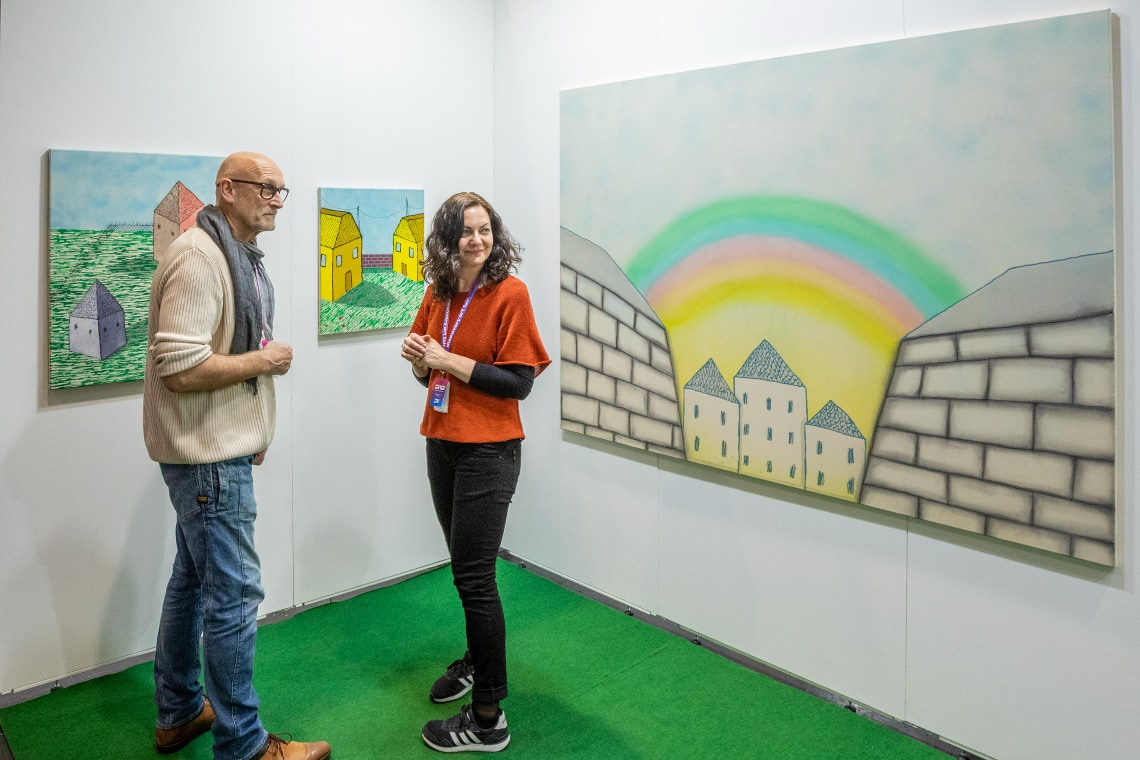
David Luca Muth – Gallery artpark – booth at DAF, photo by Holger Peters with Kai Brückner and Klaudia Kelleh
Hanna Kim – Booth E3, Galerie Klose
As a child, Hanna Kim found a brown book tucked into a corner of her father’s study. Its cover carried an enlarged reproduction of Napoleon’s coronation, and its pages were full of nineteenth-century painting. She says she couldn’t put it down. Born in 1981 in Buyeo and trained in Korea, Kim now builds her canvases with a wide hake brush, sweeping color horizontally and vertically before staging everyday scenes on top. She calls the result dichotomous: abstraction and figuration, reality and surrealism, held in a single picture. Her backgrounds blur like watercolour, as if time had run through them. In front of them sits a boy, or a cat, solid and entirely unbothered.
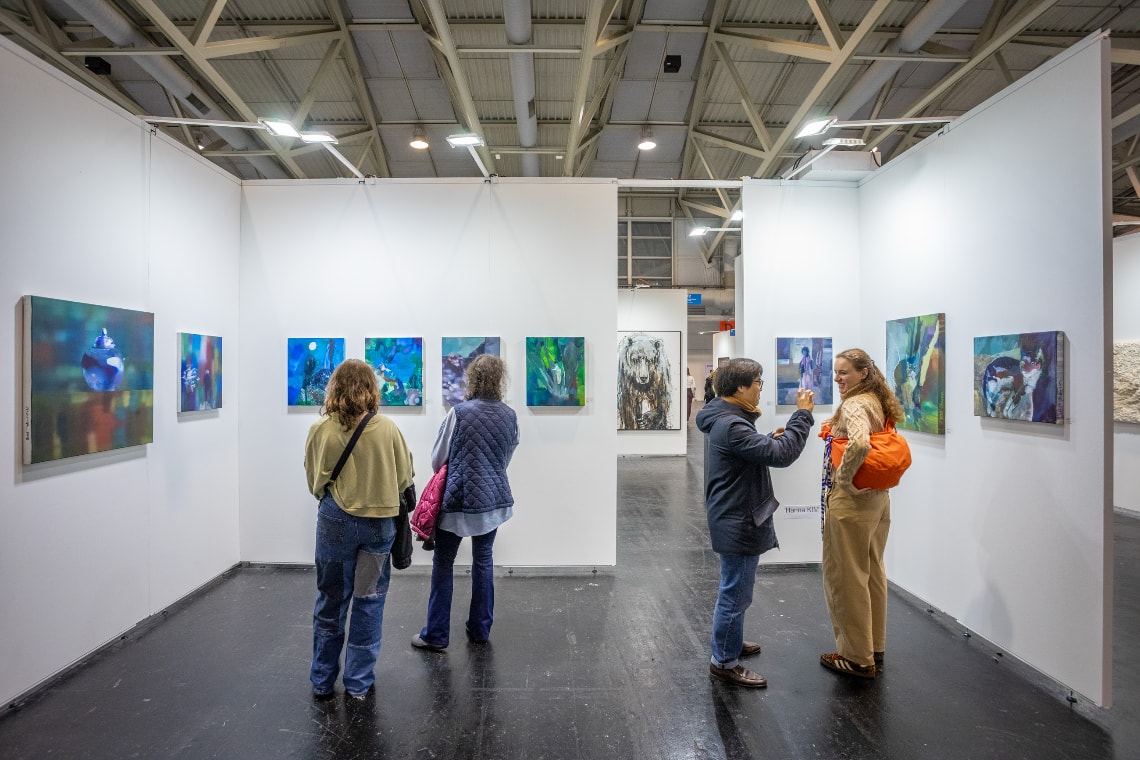
Hanna Kim – Galerie Klose – booth at DAF, photo by Holger Peters
Perspicere – Booth E4, Prescription Art
The name is Latin for “perspective,” which is fair warning. Up close, a Perspicere portrait is a thicket of crossing lines; step back, and a face resolves out of it, ghostly and exact. The method is disarmingly simple: a single length of sewing thread wound around nails, never cut, like a drawing made without lifting the pen. Self-taught, the London-based artist came to thread by accident, when he mapped out a wall commission for a gallery in string. He is colorblind, which partly explains his long loyalty to monochrome. On the street he has been known to destroy portraits once they are finished, and to film the undoing. In 2022 he was reportedly awaiting Guinness World Records confirmation for the largest thread portrait ever made.
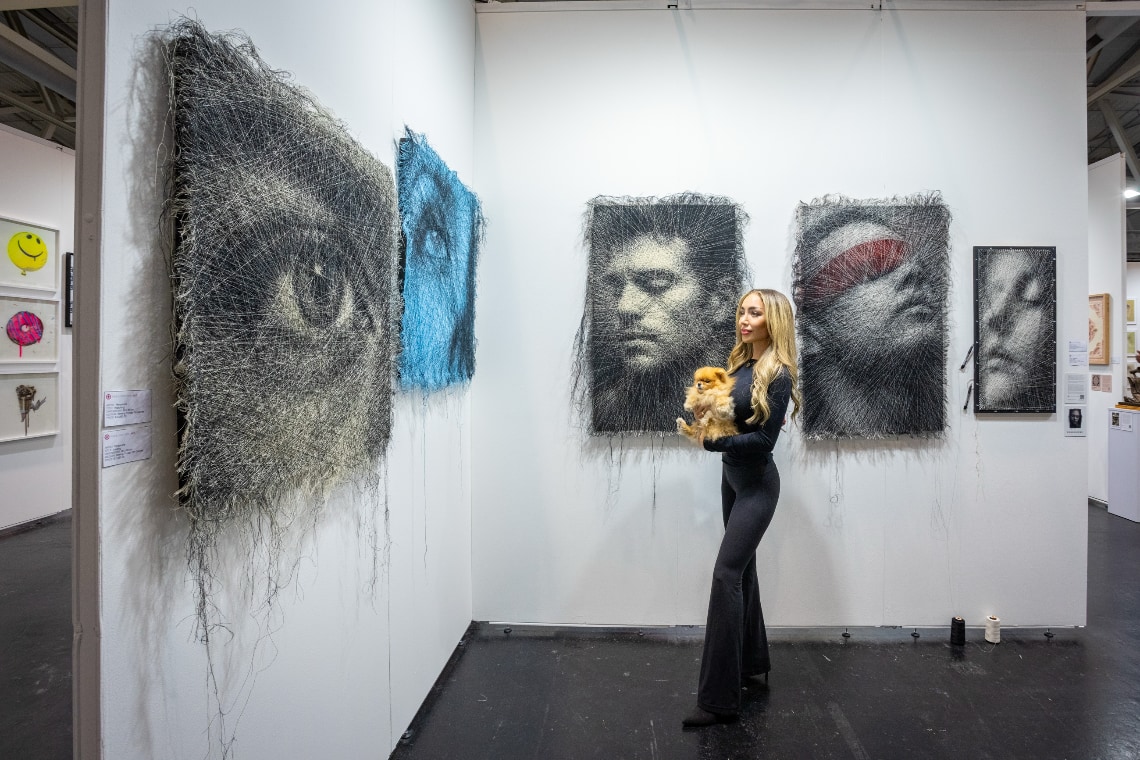
Perspicere – Prescription Art – booth at DAF, photo by Holger Peters
Christoph Eberle – Booth F4, VERMEER Magazine
As a schoolboy, Christoph Eberle saw Vermeer’s The Art of Painting and, as he tells it, knew that was what he wanted to do. It’s hard not to smile, then, at the name of the magazine that nominated him. Born in 1969 and based in Zurich, Eberle trained as an architect at ETH, worked as a freelance graphic designer for more than twenty years, and taught himself to paint. His hyperrealist oils start from photographs but are constructed rather than copied. At the booth, an espresso machine is set against flowers, chrome and petals given the same patient, almost devotional attention. The method allows him only a handful of paintings a year, and each one shows it.
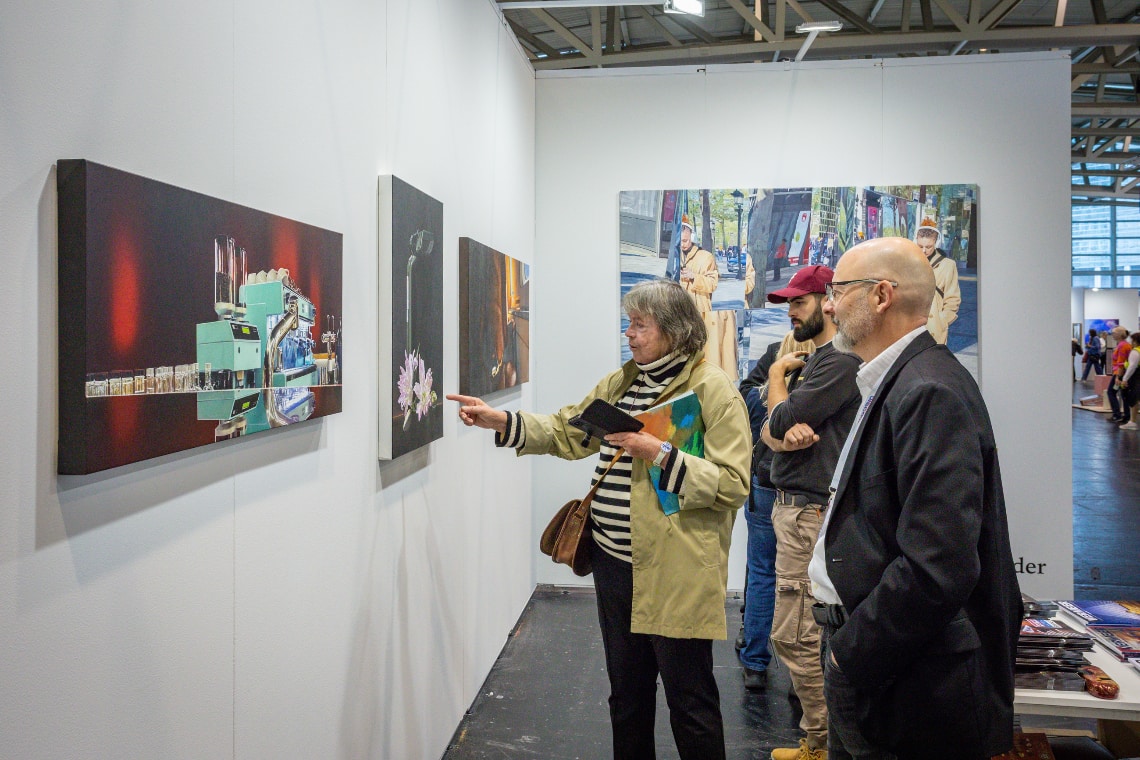
Christoph Eberle – VERMEER Magazine – booth at DAF, photo by Holger Peters
Five introductions, then, and five reasons to walk the Gallery Section slowly. Find the booths, ask about the work, and leave knowing a few more names than you came with. Discovery Art Fair Frankfurt runs through November 1, 2026, in Hall 1.2 at Messe Frankfurt, open 11 am to 6 pm on Sunday.
Photos: Holger Peters