




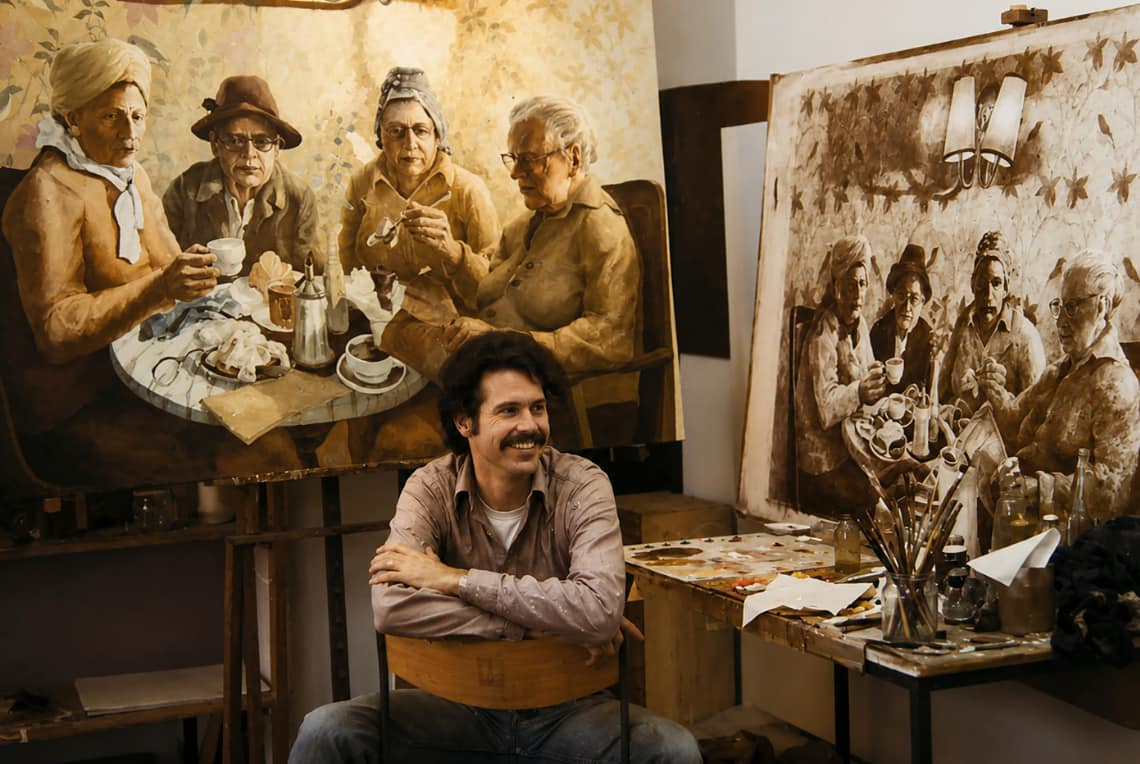
Three nudes lurch across a canvas in candy pink and orange, their heads dissolve into blocks of raw color. A few feet away, a snow-shrouded Alpine village waits behind a screen of bare, blood-red trees, every roof and window rendered with the patience of a man who wants you to count them. Same painter. Same decade, more or less. And if you did not read the signature, you would never guess.
That refusal to stay in one place – stylistically and thematically – is, to my eye, the most honest thing about Glenn Gibbs.
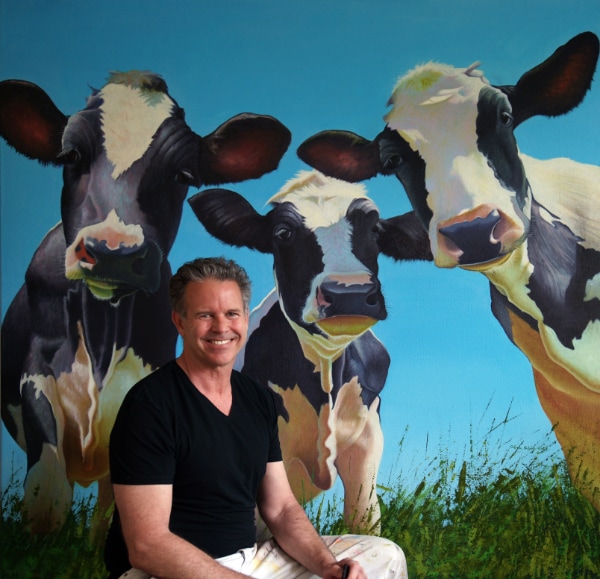
Glenn with Calves, 180×200 cm, Oil on Canvas, 2012
A Canadian in the German School
Glenn Gibbs was born in 1954 in Pouce Coupe, British Columbia, and has lived and worked in Germany for most of his life. He trained at the Hochschule für Bildende Künste in Braunschweig, absorbed the hard clarity of the Neue Sachlichkeit painters, such as Beckmann, Dix, and studied Balthus and Hockney with equal seriousness. Later, at the Kunstakademie Düsseldorf, he became a Meisterschüler under Konrad Klapheck. In 1989, his painting Marientor was acquired by Johannes Rau, then Minister-President of North Rhine-Westphalia, and hung in the Düsseldorf State Chancellery. Recognized and awarded for his fruitful career, Gibbs is more interesting to art aficionados for what he has done in his art.
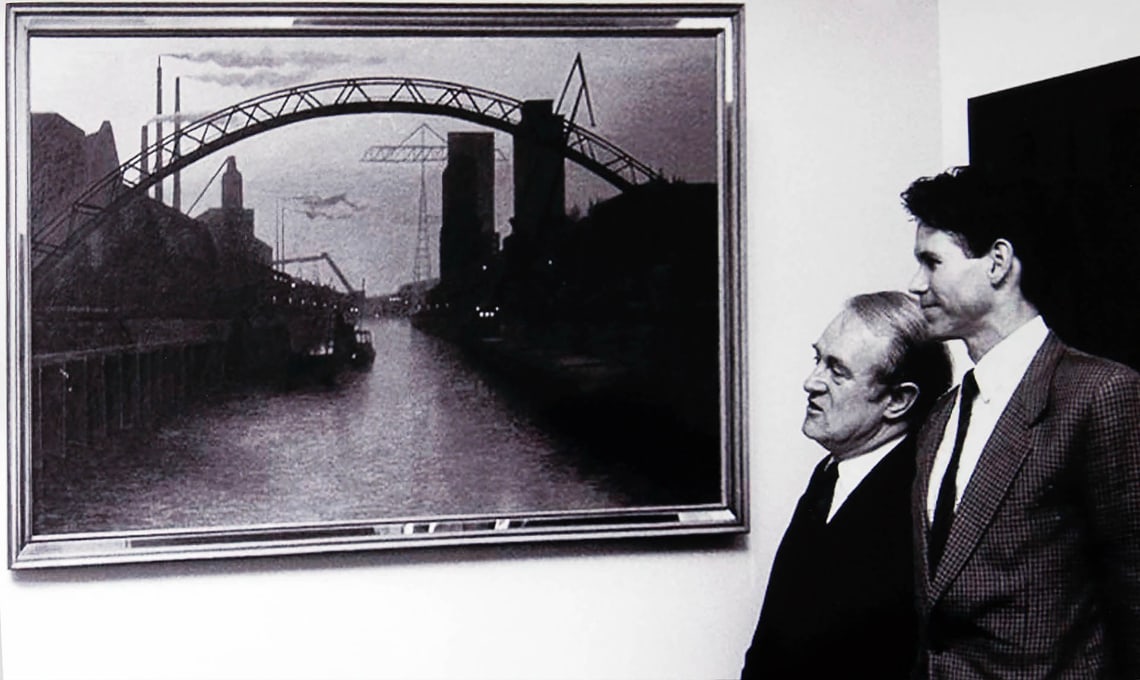
Glenn with Johannes Rau in 1988
The Many Hands of One Painter
Here is a painter who can hold three cows in tender, photographic close-up, including wet noses, lashes, the exact weight of an ear. And then, in another room, dissolve a group of men into abstract shapes and forms that read as color and gesture first, bodies second if at all. This is not realism loosened; it is a different mode altogether. Call it associative abstraction, an art that lives in an abundance of color and reference, where one thing summons another and the eye is never allowed to settle.
The historic movements he absorbed early, the Neue Sachlichkeit intellectual clarity of Beckmann and Dix, are still in the work, but they now sit alongside surrealism, pop art, Far Eastern motifs, and the recognizable motifs of present life: a bicycle, a clock, a lacquer cabinet. The symbolism is intellectual and deeply personal, yet it stays relatable. He experiments with his materials to match, gloss, edge, and surface pressed into service, so that how a thing is made becomes part of what it means.
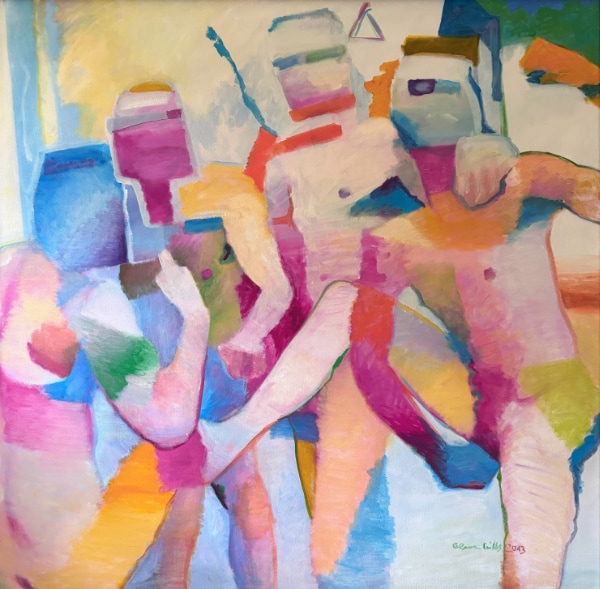
Glenn GIbbs – An Arrangement of Men 130 x130 cm. Oil on canvas 2013
Making the Material Speak
Around 2015, Gibbs left oil for acrylic and began working with epoxy resin, hammered metal, and Plexiglas, chasing a single question: how much does the material itself decide what we see and feel? Gloss, edge, and depth stopped being background and became the statement. And then, after more than a decade of that, he circled back to his first love, oil and realism. Not as a retreat, but as another room to work in.
Come see Glenn Gibbs at the Discovery Art Fair in Frankfurt from October 29 to November 1, 2026, and decide for yourself which hand is the true one. I suspect the answer is all of them.
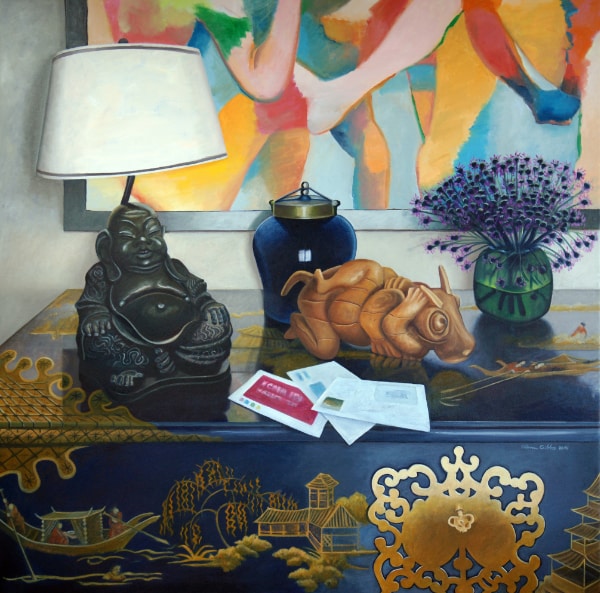
Glen Gibbs – Objects of Affection, Öl auf Leinwand, 130×130 cm, 2013